

What I Know, Standing Here
From the first step forward, and everything that followed.

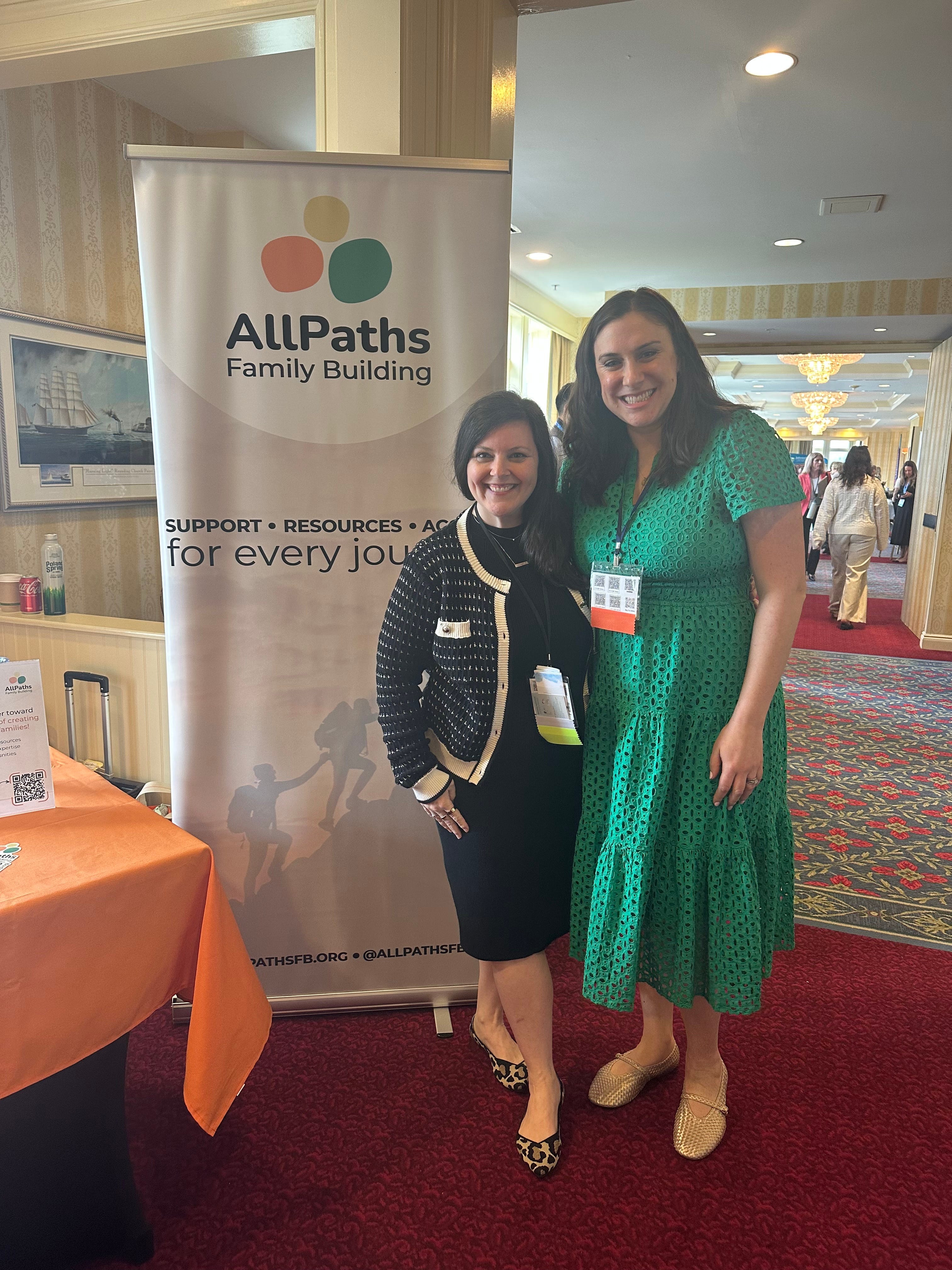
This weekend I attended the New England Fertility Society annual conference.
It was a time of learning. Of reconnecting with colleagues. Of hallway conversations that picked up exactly where they left off a year ago.
And, of course, of that fun party trick known as: “Oh my goodness—you’re the first IVF baby.”
There is always a moment. A pause. A recalibration.
For those who haven’t met me yet, I become the headline before I become the person.
And I understand it. I really do.
Because what I represent is bigger than me.
But standing there—name badge on, coffee in hand, moving between rooms filled with the people shaping this field—I am always aware of the quiet tension between who I am and what I symbolize.
Which is why I keep coming back to this: I am not the future of IVF.
I am its history. It’s present. And in some ways, still its question mark.
There is something disorienting about realizing you have crossed that invisible line—
from what comes next to what came first.
For so long, I was the proof point. The possibility. The answer to a question people weren’t even sure they were allowed to ask yet.
Would this work?
Would she be okay?
What happens if we try?
I was the “what happens?”
And now, I stand in rooms like this—rooms full of brilliance, precision, innovation—and I watch an entire field exist because people once held their breath and chose to believe in something they could not yet see.
What I know, standing here, is that science moves faster than the stories we tell about it.
The labs have evolved. The protocols have sharpened. The conversations at conferences like this are more sophisticated, more data-driven, more expansive.
But the human experience? It is stubborn in its sameness.
Hope still feels like a fragile thing you carry in both hands, careful not to drop it.
Waiting still stretches time in ways that make no logical sense. And grief—when it comes—still arrives quietly, without permission, without a roadmap for how to hold it.
We have advanced the science. But we have not outpaced the heart.
What I know, standing here, is that being a beginning is not the same as being a solution.
It would be easy—comfortable, even—to treat my existence as a closed loop.
To say: Look. It worked. We figured it out.
But that’s not what happened.
I didn’t end the conversation. I opened it.
And you can feel that in rooms like this. In the questions still being asked. In the sessions about access, about equity, about how to make this not just possible—but reachable.
Because if something is possible, then the next question becomes unavoidable: Who gets access to it?
And that question? We are still answering it. Poorly, in too many places.
What I know, standing here, is that access is not a footnote—it is the story.
You can feel it just beneath the surface of every innovation. Every breakthrough carries an unspoken companion: Who will this reach?
I have watched people fight for the chance to even try.
Fight insurance systems. Fight state lines. Fight timelines that don’t care about biology, budgets, or breaking points.
I have watched hope get priced out of reach.
And I have watched people carry that quietly, because infertility already asks them to hold so much.
We celebrate outcomes. We spotlight success stories. We gather in beautiful places and talk about what’s next.
But possibility without access is a cruel kind of optimism.
It tells people, “Look what can happen,” without answering, “How do I get there?”
What I know, standing here, is that I have lived my entire life inside a conversation most people only enter when they have to.
For many in these rooms, this is their work.
For patients, it is their life—for a chapter, or sometimes much longer.
For me, it has been both. Always.
It has introductions that start with my origin story.And moments where I am reduced to a milestone before I am understood as a person. It has been learning how to carry the weight of what I represent without letting it eclipse who I am.
Because I am proud—deeply, unequivocally proud—of what my life stands for. But I am also clear-eyed about what my life does not solve.
What I know, standing here, is that we are still asking people to do something incredibly hard… without building a system that truly holds them.
We tell patients to advocate for themselves.
Ask questions.
Push for answers.
And they do.
But too often, they are doing it alone.
They become the coordinators of their own care.
The translators of their own medical journeys.
The keepers of timelines, logistics, medications, emotions.
And they do it while trying to build a family. There is something fundamentally misaligned about that.
What I know, standing here, is that infertility is not a moment.
It is not something that begins neatly with a diagnosis and ends cleanly with a result. It reshapes how people move through time. Through relationships. Through themselves.
It changes how you hope, plan, and allow yourself to imagine.
And even in rooms filled with success stories—even here—there is an undercurrent of knowing. That none of that disappears just because the science worked.
What I know, standing here, is this: I am not proof that the work is done.
I am proof that the work matters.
That it is worth investing in. Fighting for. Worth improving—not just in labs, but in policies, in access, in how we hold the people walking through it.
I am one life that began because someone believed in what could be possible.
And every time someone says, “Oh my goodness—you’re the first,” what I hear is not just awe.
I hear responsibility.
Because being the first doesn’t mean the story is over.
It means you go first.
And then you turn around—in conference halls, in clinics, in conversations that matter—and you look at everyone coming behind you—and you say, we’re not done yet.